The Surgeon Who Invented Emergency Care: The Story Behind International Paramedics Day
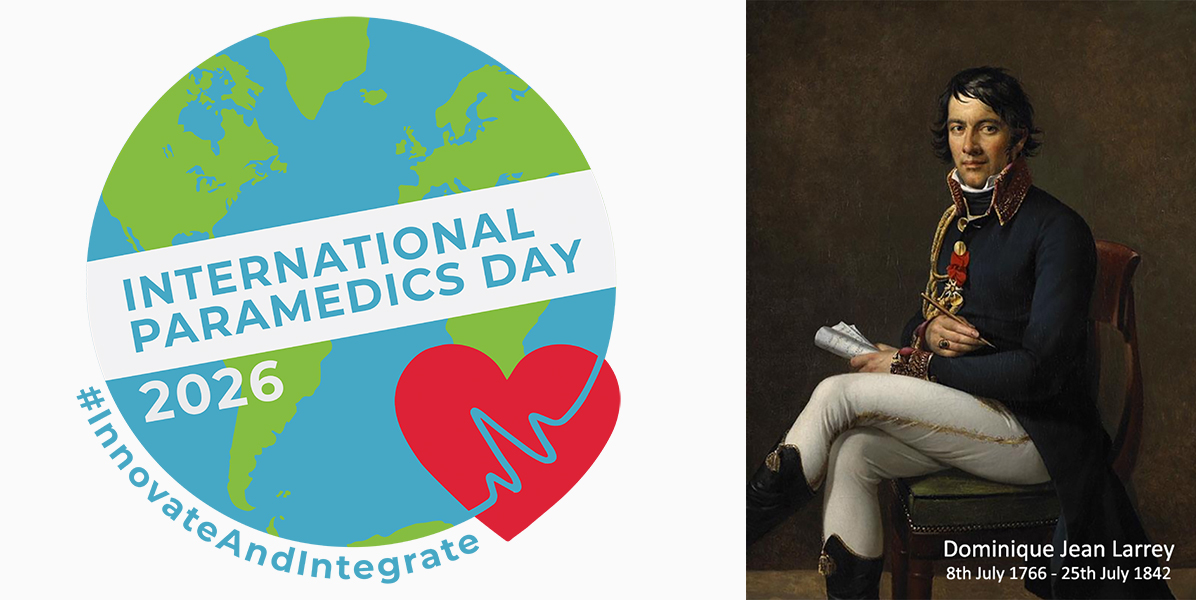
Every 8th July, the world marks International Paramedics Day - and the date wasn’t chosen at random. Much as we celebrate International Nurses Day on the birthday of Florence Nightingale, 8th July is the birthday of Dominique Jean Larrey, a French military surgeon. He was born in 1766 but his ideas still shape how paramedics work over 200 years later.
But I bet you’ve never even heard of him! Here’s a potted biography to show you why we think he should be a household name.
From humble beginnings…
Larrey had a tough start. Orphaned at 13, he was taken in by his uncle, a surgeon, and trained in Paris before joining the French Navy as a medical officer. When France went to war in the 1790s, he volunteered for the front line - and what he saw there changed the course of emergency medicine.
At the time, military medics were kept miles behind the fighting. Wounded soldiers had to make their own way back for treatment or rely on comrades to carry them; those without rank or connections could wait days, if they were treated at all.
The best ideas are often simple ones
Larrey thought this was madness. His solution: a fast, light horse-drawn carriage - padded, sprung for comfort, and fitted with a fold-down ramp that doubled as an operating table - that could reach casualties quickly and get them treated fast. He called it the "flying ambulance," and despite resistance from military leadership, it made its debut in 1793. It's not a bad description of what an ambulance still does today.
And then the triage system
Alongside it, Larrey introduced something even more radical: treating patients by the severity of their injuries, not their rank or nationality. Enemy soldiers were treated the same as his own - a principle that still sits at the heart of triage now. He also worked out that operating within the first hour gave patients their best chance of survival, a theory grounded in how the body responds to shock. He was clearly good at what he did too - he's said to have carried out 200 amputations in a single 24-hour stretch at the Battle of Borodino in 1812.
Napoleon noticed
It was this reputation that brought him to Napoleon Bonaparte's attention. Larrey went on to serve as chief surgeon of Napoleon's Grande Armée, following the Emperor through campaign after campaign across Europe and from Egypt to Russia. Napoleon held him in genuinely high regard, reportedly describing him as “the most virtuous man” he had ever known, high praise from a man not known for handing out compliments! Larrey's flying ambulances and triage system became standard practice across Napoleon's forces, saving a staggering number of lives at a time when battlefield medicine offered little more than a coin toss.
A last-minute reprieve
Larrey's own story nearly ended on the battlefield. After Napoleon's final defeat at Waterloo in 1815, Larrey was wounded, captured and ordered to be executed by Prussian soldiers - only escaping death when a Prussian surgeon treating his wounds recognised him. It turned out Larrey had once saved the life of the enemy general's son and so he was pardoned on the spot. (Now there’s kharma for you!)
An incredible legacy
Larrey spent his later years back in France, working as medical director of the veterans' hospital at Hôtel des Invalides, before he died in 1842 at the age of 74, just three days after his wife.
More than two centuries on, the ideas he introduced - rapid evacuation, treatment prioritised by need and getting critical care to the patient fast - remain the backbone of every ambulance service in the world. It's exactly why his birthday was chosen as the date for International Paramedics Day: a fitting tribute to the man who, in many ways, invented the job.
Source: Biography of Dominique Jean Larrey, International Paramedics Day (internationalparamedicsday.com) hyperlink to https://www.internationalparamedicsday.com